Friday, June 10, 2016

June’s the time to start your Business tax planning

 June is a great time for mid-year tax planning. It may sounds strange to be talking about taxes as we begin the summer months. But time flies and the end of the calendar year will be here before you know it. Creating a tax reduction strategy is much easier when you have time to put your plan into action.
At the end of 2015, the Protecting Americans from Tax Hikes Act of 2015 (PATH) was passed preventing a tax increase that would have affected middle income taxpayers and families, especially those with small businesses. The PATH Act made many popular tax benefits permanent, including the ability to make charitable contributions directly from an IRA, the American Opportunity Tax Credit, and the teachers’ classroom expense deduction. Other popular tax benefits, such as the Work Opportunity Tax Credit, were extended for multiple years, a much better result than the year by year piecemeal approach that was becoming too common.
The legislation included in the PATH Act is extensive and, in some cases, complex in nature. In order for you to take advantage of potential tax saving opportunities, we’ve highlighted a few of the major provisions you should consider during your mid-year tax planning efforts.
Time to convert to a C-corp?
Business owners should evaluate whether it is in their best interest to convert to a C corporation since the maximum tax rate is currently 35 percent and may drop further if Congress decides to act on other corporate reform proposals. For individuals, the maximum income tax rate is 39.6 percent. In addition, the marginal tax rate for higher income families could be subject to an additional 3.8 percent tax on certain types of investment income including interest, dividends, capital gains, rental income, etc. Business income from pass through entities cause many business owners to pay tax at higher marginal rates since the company’s income is taxed on their personal returns.
The PATH Act made permanent the ability to exclude 100-percent of the gain on the sale or exchange of qualified small business stock held for more than five years by non-corporate taxpayers. This could provide a tremendous tax savings when ultimately exiting your business.
However, the above should not be the only considerations in determining whether a business should convert to a C corporation or remain a pass through entity. There are many tax benefits to operating as a pass through (such as the avoidance of double taxation) so be sure to consult with a knowledgeable professional regarding your specific circumstances.
Assess your equipment needs
If your business needs new equipment (or other depreciable property), consider making the acquisition in the next six months to take advantage of enhanced deductions made available by the PATH Act. You may be eligible to immediately “expense” the full cost of equipment, machinery, furniture, vehicles and other qualifying assets. The PATH Act made permanent the previous limits of $500,000 and $2 million, indexed for inflation in future years.
In addition, the PATH Act reinstated the ability to claim bonus depreciation on fixed asset purchases. However, this provision was not made permanent but instead will expire after 2019. This deduction will be phased out through 2019, with a 50 percent deduction being allowed for 2015-2017; a 40 percent deduction for 2018; and a 30 percent deduction for 2019.
Can you claim the R&D credit?
One of the biggest tax breaks included in the PATH Act is the revival, and permanent extension, of the tax credit for increased research expenditures. The Research and Development Credit (R&D Credit) is valuable, but because its complexity is often misunderstood, the benefits of claiming this credit is often overlooked. However If your business conducts research in connection with developing new or improved products, technologies or processes, you may qualify for the R&D Credit. The credit is available to businesses in a wide range of industries, including manufacturing, technology, health care, construction, agriculture, etc.
In addition, because many businesses that are involved in R&D activities are not yet profitable, the PATH Act allows for the R&D credit to be claimed against payroll tax liabilities. This change to the way the R&D tax credit can be claimed will provide an immediate cash boost to those innovative businesses that need it most.


Thursday, June 9, 2016

Smart Tax Planning Strategies for Graduation Year

FROM http://www.huffingtonpost.com/

June isn’t just for weddings; in many cases, it is for another life change that comes with possible large tax return implications - graduation. Graduation is a time of changes; it begins with looking forward - to your child’s new adventures and their entry into the “real world” and then planning for them and possibly for you.
When it comes to higher education and taxes, planning is important because there are many credits and deductions and various qualifications for each. It is important to know what steps to take to achieve the most beneficial tax situation for your family. As with any other life change, there are a number of considerations that come into play. Though you may have contributed a lot to your graduate’s support this year, you may actually end up with higher taxes if you don’t plan carefully. Furthermore, not only should you plan carefully for this year, but for next year as well

Probably the most important thing to determine in the year of graduation is whether your graduate is still your dependent. While it may feel like you are still supporting your kids, the IRS requires that your child not be paying more than half of their own expenses for you to claim them. You have to add up all the money they spend as well as the money you and others spend. Unfortunately, it is not unusual in the year a child graduates to lose their dependent exemption even though you are still spending a lot of money on them. Losing the dependent exemption means a $4,000 increase in taxable income AND not being able to claim an education credit for any of the college tuition you paid during the year. And, if you qualify to claim your child as a dependent, but don’t - they cannot claim their own exemption!
You may also lose your Head of Household filing status when you lose your dependent. The rules require you to have a dependent child or other dependent to claim the Head of Household filing status. If your graduate was your qualifying dependent, your filing status would change to Single or Married Filing Separately. This can result in much higher taxes because your standard deduction decreases and your taxes increase. Add to that the loss of an exemption, a change in filing status, AND the loss of any related Education Credits, the loss of any Earned Income Tax Credit you may have been eligible for based on your graduate and you can see you can suffer some pretty dramatic changes in your tax life when your child graduates.
And that empty nest you may or may not been looking forward to, well if your graduate moves back home because they can’t afford to live on their own, you may not be able to claim them next year either. The rules concerning our children specifically change once they are over 18 and are no longer a student, or once they turn 24. You can only claim them as a dependent if their total income for the year is less than $4,000, they live with you, and you provide more than half their support once they turn 24.
Some good news, you are still eligible for the interest deduction on student loans, which is currently up to $2,500 a year, even if you don’t itemize deductions or claim the graduate as a dependent. The student loan must be in your name and have been taken out when your child was still your dependent, you can claim the interest you paid to reduce your taxable income.
As has been said before, life changes can impact a tax return even more than tax law changes. Having a dependent graduate is exactly one of those life changes and most of those changes aren’t good - things like lowering the size of your refund or increasing the amount you owe.
Once all the pomp and circumstance is over, parents and the graduate are left coping with mixed emotions. Pride and joy about completion of a college career and the stress and fear of the question “what’s next?” Generally, it is a best practice to plan and review your tax situation, but it is even more important when you are facing life changes. The planning part can be overwhelming and you may want to speak to your tax pro or review the detailed information about education tax benefits, on the IRS Tax Benefits for Education information center. Having a tax plan and using sound strategies not only sets the graduate up with a great habit, it will teach them how to keep more of their money come tax time.
Another best practice is a mid-year tax assessment and summer is the perfect time to do so. For now, celebrate graduation and the milestone it is, and next week check out what you should consider during a mid-year tax assessment.

Wednesday, June 8, 2016

Mastering IRA Rollover Decisions

FROM NASDAQ.COM

By now, many advisers are well on their way to incorporating the Department of Labor’s new fiduciary rule into their investing recommendations. But there is one more area they should be considering: the rollover process for retirement plans.

Discussing with clients both the benefits and drawbacks of rollovers from a company retirement plan into an IRA is something advisers should be prepared to do.


In some ways, the issue does not seem terribly complicated. After all, there are only three possible decisions: go with a rollover to an IRA, stay with a company plan or take a lump-sum distribution.

Unfortunately, there is no one-size-fits-all template that can be used to determine which option is best for a client. Each client’s retirement plan must be evaluated individually, based on its own merit and the client’s specific situation.

There are numerous variables to consider. These include fees, available investments, services provided, the 10% early distribution penalty, creditor protection, convenience, required minimum distributions and estate planning.

Here are how some of these considerations come into play in leading to a particular final recommendation.

GO WITH A ROLLOVER

The first consideration is the status of the client. The ability to roll over is not limited to participants in the company plan. Their beneficiaries have the option to roll over funds as well.

A spouse who is a beneficiary can roll over inherited company plan funds to their own traditional or Roth IRA. Nonspouse beneficiaries can directly roll over inherited plan assets to an inherited IRA (or directly convert the inherited plan to an inherited Roth IRA).

Deciding whether a traditional IRA with continued tax deferral or a Roth IRA with future tax-free gains is a better fit can be a tough call. Does it make sense to pay taxes on the company plan funds now in exchange for tax-free distributions from the Roth IRA later?

Probably the strongest argument for an IRA rollover is the ability of a beneficiary to stretch the money for years, keeping it growing in either a tax-deferred traditional IRA or tax-free in a Roth IRA. A nonspouse beneficiary can stretch distributions on an inherited IRA over his or her life expectancy.

But many company plans do not allow the stretch option, even though the law does. Company plans often do not want to take on the headache of paying out RMDs over decades to beneficiaries of deceased ex-employees. These plans simply pay out to the beneficiary in one year, or five years at best.

Another advantage to a rollover is that IRAs are more flexible than company plans in terms of estate planning and investment choices. IRAs offer the option of splitting accounts and naming several primary and contingent beneficiaries. Clients can name anyone they wish as their IRA beneficiary.

In many company plans, a participant must name his or her spouse as beneficiary unless the spouse signs a waiver. Also, company plans may not recognize a trust beneficiary or allow disclaimers.

In an IRA, clients can customize investment choices. In addition, investment changes can be made faster in an IRA because there is usually not as much bureaucracy as in a company plan.

Another attraction of a rollover is that it is much easier to access funds in an IRA than in company plans. A client may pay tax and the 10% penalty on an IRA distribution, but would still have the ability to withdraw quickly. The company plan may have restrictions on withdrawals before age 59½. If clients are no longer working for the company and leave the money in the company plan, it still may take some time to access their cash.

Another potential appeal is that an IRA can be a convenient place for a client to consolidate all retirement funds. If that is done, there is no need to keep track of several different retirement plans.

IRAs can be aggregated for calculating RMDs. The employee usually has to take his RMD from each company plan separately.

STAY WITH A COMPANY PLAN

For some clients, keeping the funds in the company plan or moving the funds to a new employer’s company plan will make the most sense. What factors weigh in favor of sticking with a company plan?

If a client is interested in delaying RMDs as long as possible, continuing with the company plan may be a good idea because of the still working exception that may apply. If a client is still working for the company where he has the plan and he doesn’t own more than 5% of the company, he may be able to delay the required beginning date until April 1 of the year after he retires. This rule does not apply to IRAs.

At the other end of the time spectrum, clients who may need their retirement funds early should also give serious consideration to sticking with the company plan. If a client is at least 55 years old when he leaves his job, and he needs to tap retirement funds, distributions from the company plan will be subject to tax but no 10% penalty. But if the funds are rolled to an IRA, withdrawals before age 59½ will be subject to the 10% early withdrawal penalty. The age 55 exception does not apply to IRA distributions.

For public safety employees in either a defined benefit or defined contribution plan, the funds can be withdrawn penalty-free if the separation from service was in the year the employee turned age 50 or older. This opportunity is lost if funds are rolled over to an IRA.

For some clients, creditor protection may be a concern. Company plans have an advantage here, as they receive federal creditor protection. State laws protect IRAs, and they can vary significantly. If a state offers limited or no creditor protection, the case may be stronger for keeping the funds in a company plan instead of rolling over.

An IRA cannot be invested in life insurance, but life policies can be held in a company plan. For some clients, the life insurance offered through their company plan may be the only such coverage a client can qualify or pay for.

TAKE THE MONEY NOW

Taking the money and running may sound like a bad idea at first, yet there may be very good reasons it would be in a client’s best interest not to roll over.

If a lump-sum distribution from a company plan includes highly appreciated company stock or bonds, a client may roll it over to an IRA, but he may not want to. Under a special tax rule, the participant can withdraw the stock from the plan and pay regular income tax on it, but only on the original cost to the plan and not on what the shares are worth on the date of the distribution.

The difference is called the net unrealized appreciation. A client can elect to defer the tax on the NUA until he sells the stock. When he does sell, he will pay tax only at his current long-term capital gains rate. The ability to use the NUA tax break is lost if the stock is rolled to an IRA.


Tuesday, June 7, 2016

Using IRA to fund real estate can be tricky

FROM http://www.abqjournal.com/

Real estate is a permitted investment in either a traditional or a Roth IRA account. However, it is essential that the acquisition, operation or disposition of the property not result in a prohibited transaction as defined by IRC Section 4975. Engaging in a prohibited transaction with the IRA will result in loss of its status as an IRA with a (deemed) immediate distribution of the assets to the beneficiary.

The termination occurs as of the first day of the year of the prohibited transaction and the deemed distribution of assets will be subject to immediate tax and perhaps penalties for early distributions.


I have been asked this question many times. I usually begin by noting that there are many areas of tax law that I might be regarded as an expert in, but qualified retirement plans and IRAs are not within those areas.

In fact, there are not many people who are experts in these areas. That can be troublesome because many sponsors of self-directed IRAs will provide tax advice on real estate investments in IRAs that is less than definitive.

After my “no expert” introduction, I note two issues that are of concern. First, the penalty for violating the prohibited transaction provisions is much more severe than is typically encountered in tax planning – the immediate death of your IRA.

This penalty suggests the need for strict compliance with the rules. But my second issue is that the rules are not very clear, even to experts.

The prohibited transaction rules are found in two places – ERISA and the Internal Revenue Code. The Department of Labor administers ERISA and sometimes issues advisory letters on issues such as prohibited transactions.

The IRS protects the government’s interest in the tax laws and sometimes litigates cases dealing with prohibited transactions.

The need to consider both the views of DOL and IRS confounds getting clear advice on what constitutes a prohibited transaction. This is exacerbated by the death penalty issued to violators.

So advisers usually fail to give an actual “opinion” on prohibited transactions. Instead, they provide a “weasel worded” letter that concludes nothing. The letter is usually an insult to the average weasel.

We know prohibited transactions would include selling property to the IRA, buying property from the IRA, loaning money to the IRA, providing services to the IRA and receipt of any personal compensation.


So, in your case, I’m sure the argument is that the management services are provided to the LLC, not the IRA, and that you receive no personal compensation for any services.

But you should also avoid using your services to enhance the value of the IRA’s investment in the LLC. Providing value-enhancing services without compensation could be viewed as an indirect contribution to the IRA.

The Labor Department, in Opinion Letter 200-10A, allowed an IRA owner to be the general partner of a limited partnership that invested IRA funds in a Bernie Madoff fund. The IRA owner represented he would not manage the investments.

I’m trying to be more of a cautious adviser, providing an objective analysis and not a wet blanket. But, if the IRA investment is renovating homes and you are the manager, you need to avoid day-to-day oversight and handling any work yourself.

Even if services are not compensated, if they enhance the value of the IRA real estate investment, the value of foregone compensation by the owner can be an indirect contribution to the IRA.

Monday, June 6, 2016

Unique tax issues affect those with foreign connections

FROM http://www.floridatoday.com/

If you are like most people, it is fun to travel especially all around the US and all over the world. Actually, I recently traveled through Europe on vacation. It is great meeting people from other countries and hearing their stories. As a tax practitioner, I have met many people from many different foreign countries. I have served clients that were from Great Britain, Germany, Ireland, Sweden and even Norway.
They have all come to see me for various reasons. In this article I thought I would talk about some of the various scenarios in which someone from a foreign country would need to be aware of the tax trap that may be set for them. But be aware as some of these issues apply to U.S. citizens with assets abroad or income earned in a foreign country.
If you are a dual citizen of a foreign country and the U.S. or a resident alien, you are subject to federal income tax in the United States. The U.S. government, via the Internal Revenue Service (IRS), gets to tax 100 percent of your worldwide income.
A resident alien is defined a someone who spends more than 183 days in the U.S. in the current year (or the look-back period). The look-back period counts 100 percent of the days spent in the current year, 1/3 of the days in the previous year and 1/6 of the days in the year before that. So you could literally spend 125 days in the U.S. for each of the last three years and still meet the test as a resident alien and be required to file an individual tax return and pay U.S. tax on your worldwide income.
This next quagmire you need to be aware of applies to U.S. citizens and resident aliens. In general, if you are a United States person who has a financial interest in or signature authority over at least one financial account located outside of the United States you have a requirement to report to the U.S. government, through the U.S. Treasury, that you have this account. However, if you have less than $10,000 (in U.S. dollars) in all of your foreign bank accounts, there is not a separate reporting required. Unfortunately, this amount is determined by looking at the highest balance in your accounts during the calendar year. So if the highest balance in account A is $9,000 and the highest balance in account B is $2,000, then you are required to report this to the U.S. government. This is the case even if the balance at the end of the year may be $5,000 total in both accounts.
Should the aggregate of the highest balance of your accounts exceed the $10,000 limit, then you need to file Form 114, Report of Foreign Bank and Financial Accounts by June 30, 2016 for the 2015 calendar year. There are no extensions available for this form. The maximum penalty is $10,000 per violation. The form is required to be filed for each year in which you had this account. If the account is a joint account, each individual is required to file the Form 114. Now the final kicker, this has to be filed electronically. Effective July 1, 2013, the IRS no longer accepts paper filing of this return. You can go to http://bsaefiling.fincen.treas.gov/main.html to find out how to electronically file or contact a tax advisor who has experience with this form. Please note, the 2015 e-filing of Form 114 is the last one with a due date of June 30. Starting with the 2016 calendar year filing, the FBAR returns will be due starting April 15 of each year.
One final note on the FBAR forms. Please be sure to report the income that is generated on the accounts you report on the FBAR forms. If you fail to do so, this can be a criminal matter as that is looked as tax evasion. If you have a foreign bank account, did not report the income you will need a referral to an attorney to assist with this type case. Please call our office for a referral to a qualified attorney.
Of course we cannot forget the nonresident aliens. These are the people who come to the US and generally spend 90 days or so a year but they either earn money, own property or have both (but the same 183 day rule stated earlier still applies). In their case, they need to file a tax return to pay taxes on the income earned or the gain realized on the sale of property. So for that foreign national gentleman who sold his house in Cocoa Beach that he owned for four years as a rental, the buyer of the property (this is handled by the title company) is required to take federal withholding from the sales proceeds. There is an option for the nonresident to opt out of this, but you need to consult a tax adviser well in advance of the closing to make sure this is handled properly. The foreign seller will need to file Form 1040NR in order to obtain a refund of any overwithholding.


Sunday, June 5, 2016

Myths Concerning Roths, IRAs, And RMDs

FROM SEEKINGALPHA.COM

Summary

I made a killing by putting my Apple stock in my Roth rather than my IRA where I would have to pay taxes on the gains.
A Roth will never require a minimum distribution from it.
An IRA to Roth conversion only makes sense if you have many years for your earnings to grow tax-free in the Roth.
I have a high income right now, so it makes sense for me to put 100% of my savings in the tax-deferred 401(k) instead of the Roth 401(k).
I want all my money in the Roth because I don't want to have to deal with the forced RMDs required of IRA owners.
Source: Bogle Financial Markets Research Center
How many have ever watched the show Mythbusters? Do you know which of the opening five statements are myths or at least not totally true? Many believe that they understand everything they need to know about Roths, IRAs, and the RMD (Required Minimum Distribution for those IRA owners).
Much like another well-known SA author's recent article titled Dividend Growth Portfolios MUST Have 45 (And Only 45) Positions, not everything is as it seems by just reading the title and the summary bullet points.
My wish is not to try and make you an IRS or tax expert, but to at least give you enough information for you to understand some of the challenges in trying to navigate the environment of what are called tax-advantaged retirement accounts. In doing so, I hope to dispel some myths or at least provoke you to investigate on your own some of the math surrounding these tax-advantaged accounts.
Ground Rules
First, some definitions and abbreviations are in order:
  • I will use the term Roth to indicate any number of what are typically tax-advantaged retirement accounts funded with after-tax dollars for which you can withdraw all contributions and earnings tax-free later. These come in many different forms such as the Roth IRA, Roth 401(k), Roth 403(b), and others.
  • I will use the term IRA to indicate any number of tax-advantaged retirement accounts funded with pre-tax dollars for which you withdraw all contributions and earnings paying ordinary income tax on them at the time of withdrawal. You could find many types of these such as Traditional IRA, Traditional 401(k), 403(b), SEP-IRA, 457(b), SIMPLE IRA, and others. It should be noted that it is possible to have a mix of after-tax and pre-tax dollars in most of these accounts, but when I use the term IRA from now on, I will only be considering these accounts will all pre-tax dollars in them.
Let's explore what I call the three most common levels of tax advantage that you can receive when investing.
  1. Level one-half. This typically comes out of what is called a taxable account from the generation of long-term capital gains or qualified dividends. Our current progressive tax code gives these gains a reduced tax rate that results in a reduction in the taxes paid. For instance, if your income is otherwise in the 10-15% tax bracket, dividends and long-term capital gains will fall to the 0% tax bracket, until they fill up that bracket. If your qualified dividends and other income are high enough to move you into the 25-35% bracket, the dividends and capital gains will be taxed at 15% for those brackets. I call it level one-half because there is no reduction on taxes for the deposits put in the account to start. The reductions for even the qualified earnings, while some can be essentially tax-free, this only occurs if you keep your total income and earnings below the 25% bracket point.
  2. Level one. This level is occupied by both the IRA and Roth accounts which get either a tax break when you put the money in the account or a tax break when you take the money out. As we shall see later, these two accounts are essentially on equal footing from the aspect of after-tax money you can spend in retirement per equal dollars earned while working, if your tax rate is the same both in and out of the accounts.
  3. Level two. This is occupied by the Health Savings Account, which is known as the HSA. This account when used properly for medical expenses and accompanied by a high deductible health insurance plan will result in two levels of tax savings; one on the money contributed and a second on the tax-free withdrawals when the money is used for IRS approved medical expenses.
This article is only concerned with the level one retirement accounts and how the IRA and Roth can be thought of in most cases as equals. It is true that the Roth and IRA each have unique characteristics that may be appropriate or at least appealing to different investors. The short list of some of these is described below:
Roth:
  • Tax deferral on all earnings inside the Roth
  • Tax-free withdrawal of all contributions and earnings (subject to a five-year holding period plus age restriction of 59 ½).
  • Tax-free withdrawal of your contributions at any time or age from a Roth IRA. A note on this as it applies to employer sponsored plans is that you should check with your plan administrator as each plan has their own set of rules as to when withdrawals are allowed.
  • Tax planning flexibility - Since there are no forced withdrawals by age 70 ½, you have more tax-planning flexibility during retirement.
  • If a Roth IRA owner dies, certain of the minimum distribution rules that apply to traditional IRAs will apply to the Roth.
IRA:
  • Tax deferral on contributions during working years will lower your taxable income while working and can increase some tax credits.
  • Increasing some tax credits could actually allow you to save more.
  • The required minimum withdrawals must begin prior to April 1st of the year after you turn 70 ½. The RMD for any year after the year you turn 70 ½ must be made by December 31st of that later year. If these are not made, you can incur a 50% penalty on any amount not taken that was due.
  • Inherited IRAs have a complete set of RMD tables and rules which will not be discussed here.
There are many other nuances to the above two types of accounts, and even within different types of Roth or IRA accounts, most of which can be found in the IRS publication 590, which has now been split into two parts - pub 590-A (contributions) and pub 590-B (distributions).
Assumptions for Myth Busting
To make what is commonly called an apples-to-apples comparison of these Roth and IRA accounts, we must use the following assumptions:
  • Because we can never know what future tax rates will be, each evaluation must be done at the same tax rate for each account, both at the start of the test period and the end of the test period.
  • Each evaluation must be done from the aspect of how much money did the investor need to earn to fill the account to begin with.
  • For all evaluations, I will assume that the investor earned an extra $10,000 to put towards his retirement savings.
  • That his tax rate was always 25% now and in the future.
  • This made it possible for him to put either $10,000 into a traditional 401(k) account or $7,500 (after-tax) into a Roth 401(k) account.
Let's now continue on to see if we can bust up some myths.
  1. I made a killing by putting my Apple stock (NASDAQ:AAPL) in my Roth rather than my IRA where I would have to pay taxes on the gains.
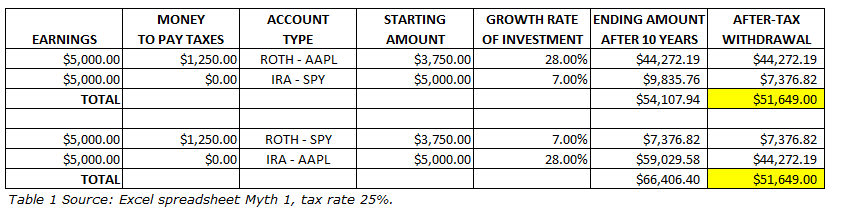
Let's compare some Apple stock with a compounded annual return around 28% over the last 10 years to the S&P 500 (NYSEARCA:SPY) with a return of around 7% over the same time period. Let's put half of the investor's earnings in AAPL in the Roth and the other half of his earnings in SPY in the IRA and then switch them around and see if one produces more after-tax income than the other. Below are the results:
While it could certainly be said that the investor did make a killing from his Apple stock investment over the last 10 years, it had nothing to do with putting it in the Roth - Busted!
2. A Roth will never require a minimum distribution from it.
This is easy, by referencing IRS publication 590-B, chapter 2 - Must you withdraw or use assets? On page 35 of the 2015 version of publication 590-B, it states:
"The minimum distribution rules that apply to traditional IRAs do not apply to Roth IRAs while the owner is alive. However, after the death of a Roth IRA owner, certain of the minimum distribution rules that apply to traditional IRAs also apply to Roth IRAs as explained later …"
This was maybe somewhat of a trick question, because to the owner, he will not have to take a distribution, but down the line, the distributions will eventually need to be taken. Let's call this one a draw depending on your point of view.
3. An IRA to Roth conversion only makes sense if you have a lot of years for your earnings to grow tax-free in the Roth. Let's also tack on another related comment that frequents this topic - the conversion only makes sense if you don't use the IRA funds to pay the tax but pay the taxes from an external account.
I will make a stipulation to the above that the taxpayer is over the age of 59 ½ so there will be no penalty on early withdrawal to pay the taxes. If you are doing a conversion below age 59 ½ and pay the taxes out of the IRA conversion, you will incur a 10% penalty on the amount of money withdrawn to pay the taxes unless one of a few exceptions applies to you.
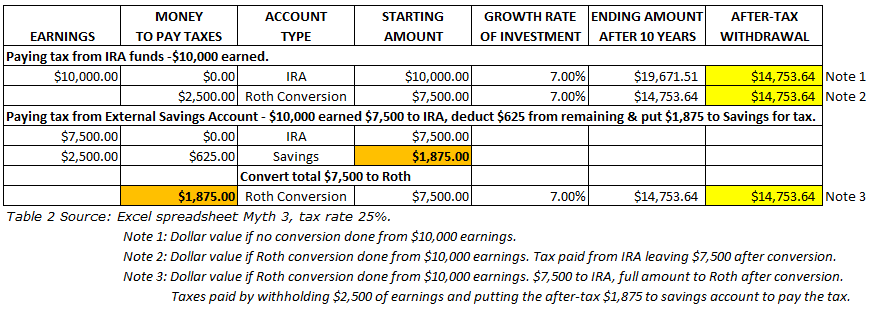
Below is a table indicating the results from three scenarios - leaving the money in the IRA, doing the conversion using the IRA money only, and doing the conversion paying the taxes from outside the IRA:
As can be seen from the above, if you make an equivalent comparison by using $10,000 earned in each case, the results are exactly the same in all three cases. The myth that paying the taxes from an outside account is better is - Busted! Also, the number of years you have until you need the money is also irrelevant since all three test cases will end with the same dollar amount given the same growth rates and tax rates for each.
Of course, if you have $10,000 in your IRA and you want to maximize the amount of money you can put in the Roth, then by paying all the tax from an external account, you can get the whole $10,000 into the Roth, but you had to earn $13,333 to do so. Whether your IRA amount is $7,500 or $10,000 the results are always equal when given equal footing.
4. I have a high income right now, so it makes sense for me to put 100% of my savings in the tax-deferred 401(k) instead of the Roth 401(k).
The myth here is that it is a good idea to put 100% of your retirement savings into the IRA and roll-the-dice on the taxes you will pay later. The risk is actually quite high that along the way of a 30-year working career and a 30-year retirement some things can change, the most important of which may be future tax rates. Other things happen in retirement that are usually unforeseen in advance and require large lump-sum payments. If these have to come from your IRA and be taxed as ordinary income, this can certainly raise your tax rate and drain more of your money than anticipated. Finally, if your IRA is quite large, the Recommended Minimum Distributions can become quite large, increasing in size by four to five percent each year starting at age 70 ½ as I outline in this article. This can also put you in a higher tax bracket than anticipated. In this case, the myth that you can foretell the future is certainly busted.
5. I want all my money in the Roth because I don't want to have to deal with the forced RMDs required of IRA owners.
The myth here is that it is a good idea to put 100% of your retirement savings into the Roth and roll the dice that by paying the taxes while you are working that you will have enough retirement money to live off, and second, because this money will be tax-free, other income such as Social Security will be untaxed as well. While this can certainly be the case if you have no other income from pensions, annuities, or taxable investing accounts, when taken to the extreme you can end up with much less total money in retirement, having wasted too much of it on the taxman during your working career. It is always a good idea to have at least some taxable income in retirement to at least fill up the tax-free bucket that the IRS gives, which is basically equal to your standard deduction plus your exemptions. In 2016, for a retired couple, both ages 65 or older, this is $23,200, and for a single person age 65 or older, it is $11,900. Imagine how lucky you would be if you had put some money in an IRA avoiding a 33% tax while you were working and then was able to take it out of the IRA and pay no tax (or a very low tax) when you were retired.
While RMDs can raise your taxable income and your tax rate in retirement, they should not be something that is feared to extremes. In an article I wrote entitled Surviving The Tax Bite of Retirement, I pointed out that over the last five years the personal exemption, standard deduction, and the top of each of the tax rate bracket have grown by around 2% per year. If this should continue into the future, with no other changes to the tax brackets, it would mean that the top of the 25% bracket for a married couple would grow from $151,900 to almost $250,000 should they both be alive for a 25-year retirement. This should be something that is considered when making a blank statement that RMDs are going to throw me into a higher tax bracket in retirement. If RMD withdrawal rates are increasing by 4% and tax bracket inflation is 2%, you would only need about a 2% yearly drawdown in your IRA to keep any tax bracket creep from occurring.
Summary
In my volunteer work helping people with their taxes each season, there are always cases where having some of their retirement in a tax-deferred IRA could have resulted in some tax-free withdrawals from that IRA, due to their low income level. The converse is also often true - that with a Roth account it would have been possible to lower how much of their retirement savings goes to the taxman. It is never a bad idea, in my opinion, to have both Roth and IRA funds going into retirement.
Conclusion
For more detailed information on these subjects covered, I suggest reading at least a couple of times the two IRS publications mentioned at the outset. Understanding the rules can avoid costly mistakes on the road to retirement as well as later when you are in retirement. I have also written an Instablog article titled Roth Vs. Non Roth (401k, 403b, 457, Etc) & The Time Value Of Money, which adds a casino example to the mix which you may find interesting.
This study is only as good as the data presented from the sources mentioned in the article, my own calculations, and my ability to apply them. While I have checked results multiple times, I make no further claims and apologize to all if I have misrepresented any of the facts or made any calculation errors.
The information provided here is for educational purposes only. It is not intended to replace your own due diligence or professional financial or tax advice.

Friday, June 3, 2016

6 Financial Planning Tips for Recent Grads and Their Families

With graduation season upon us, many college graduates, as well as their loved ones, are thinking about finances. As the new grads apply for jobs, earn their first paychecks and move in to their first homes, this is a key time to assess lifestyle expectations and financial goals.
Here are a few tips that can help young people get started on the path to financial well-being:
Start an emergency fund. Typically, as people get older their responsibilities and assets increase – as does the opportunity for unexpected expenses. Starting an emergency fund that is equal to at least three months' salary will prepare you for medical bills, job loss or other unfortunate circumstances that may occur.
Don't have the cash on hand? Try depositing a portion of each paycheck, even if it's just $50 a week; over time, you should have enough to cover you during a rainy day.

Implement a plan to pay off any student loans. Millions of Americans are saddled with student loan debt (more than $1.2 trillion, according to the Federal Reserve Bank of New York), often preventing them from achieving other life goals, like planning weddings and buying homes. Save money by examining your loans and paying those with the highest interest rates first.
If you can afford it, pay more than the minimum monthly payment to decrease your debt faster. Some borrowers may benefit from refinancing loans in order to scale back on interest. A little-known secret is that some student loan servicers offer interest rate reductions for borrowers who set up automatic payments.
Contribute enough to your 401(k) plan to get the maximum match. For most young people, their retirement years seem too far into the future to impact current decisions. However, it's incredibly important to start accumulating money in a retirement account now – many retirees delay saving and are left with a nest egg that doesn't support their standard of living.
A Fidelity analysis showed that a 25-year-old could generate $1,000 in monthly retirement income by contributing just $160 a month (assuming a 5.5 percent annual return and not taking taxes into account). A 35-year-old just starting out would need to save $270 a month to achieve the same goal, and a 45-year-old would need to contribute $500.
Ask your employer for information on its 401(k) plan and start putting away a percentage of your earnings as early as your first paycheck. They may even offer an employer match that will help your savings grow even faster. When you start, take advantage of the employer match.
As time goes on, contribute more and more with the goal of eventually maxing out your contribution each year. If your employer doesn't offer a 401(k), research other options such as an IRA or Roth IRA.
Consider a tax diversification strategy. Many financial advisors speak about the importance of investment diversification. Few, however, focus on how important tax diversification can be. Whether you decide to participate in your employer-sponsored 401(k) plan or select a different option, it's important to understand the tax implications of your plans.
For example, a 401(k) and IRA are tax-deferred, meaning participants aren't taxed until it is time to withdraw retirement funds. (It is important to note that withdrawing before the age of 59½ will incur an additional 10 percent penalty, and once you are 70½ you are required to take out annual withdrawals.)
On the other hand, Roth IRA contributions are made with after-tax dollars, so account withdrawals do not incur a tax penalty. It often makes sense to contribute to two or three accounts with different tax treatment in order to prepare for a variety of scenarios, including emergencies.

Assess your asset allocation now. If you're comfortable with risk, it may be in your best interest to start off with an aggressive asset allocation and transition to a more conservative mix as you approach your retirement years. Conventional wisdom says that young investors should hold mostly stocks, and replace equity exposure to bonds as they get older. This can vary depending on risk capacity and risk propensity.
Don't get too skittish. During times of market volatility, investors sometimes get jittery and make rash decisions that, while at the time may be comforting, hurt their investment goals unnecessarily. For example, some investors sell stocks during market dips, fearing further losses. In doing so, they lose the opportunity to recover their portfolios when the market recovers.
Similarly, during times of hardship it can be tempting to withdraw or borrow money from a 401(k). However, this is almost always inadvisable, as early redemptions from a 401(k) incur heavy tax penalties, as noted above.
Remember, volatility is part of the investing process, and if you are very concerned, you shouldn't hesitate to call your financial advisor before making a major change in your portfolio that you may regret later.

Congratulations to all of the graduates! As you venture into your career, independence and new responsibilities, there is no better time to build a strong foundation for financial success.